
DDtrust
Implementierung eines Datentreuhandmodells für den sächsischen Wissenschaftsraum an der TU Dresden
MatParNet: AI-Powered Material Parameter Identification
Identifying material parameters from experimental stress-strain curves is a critical task in materials science and engineering.
Herein lies the challenge: traditional methods for extracting these parameters often involve time-consuming manual curve fitting and iterative adjustments, which can lead to inconsistent results and significant delays in project timelines.
In our recent publication, the ILK developed MatParNet, an advanced neural network-based solution that automates the extraction of material parameters from stress-strain data.
The fundamental methodology is illustrated in the figure below.
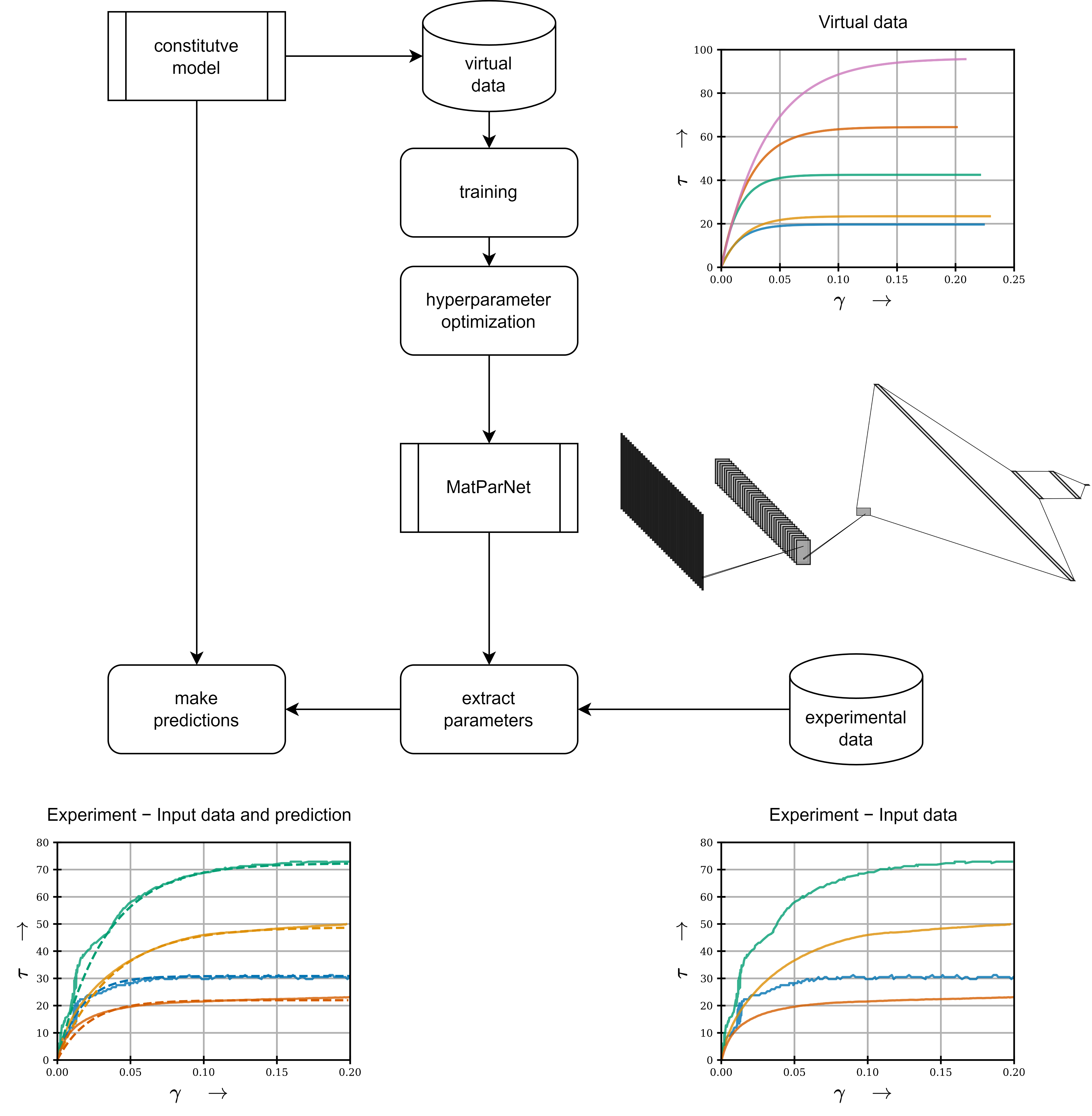
After logging into the webservice, users can upload their experimental stress-strain curves in CSV format.
The neural network processes the data and outputs the identified material parameters.
If you want, you can also fine-tune the pre-trained model using your own data to enhance accuracy for specific materials.
The final results are provided along with comprehensive analysis reports, including comparison plots and statistical metrics.
Currently, MatParNet can identify the initial shear modulus (G₀) and the decay exponent (a) for materials that follow a fundamental stress-strain relationship of the form
σ = (G₀ / a) × (1 − exp(−a ε))
For details on the model and its applications, please refer to the accompanying publication.
Data Privacy & Security
We understand the importance of data privacy and security, especially when dealing with proprietary material data.
The provided webservice is offered in collaboration with DDTrust, who act as a trusted third party to ensure that your data is handled securely and confidentially.
All uploaded data is processed by DDTrust on a fiduciary basis, no one at the ILK or elsewhere gets access to your data.
Only if you choose to fine-tune the model with your data, the resulting model will be made available to us for future predictions, but the original data remains private and is not shared or stored by us.
This approach allows us to provide you with the benefits of AI-powered material parameter identification and continuously improve our service for all users while ensuring that your data remains secure and confidential at all times.
What You Get
Instant Parameter Extraction
- Upload your stress-strain curves and receive material parameters (G₀, a) in moments
- No manual curve fitting or iteration required
- Consistent, reproducible results across different datasets and users
Pre-Trained Neural Network
- State-of-the-art deep learning model trained on extensive material databases
- Proven accuracy across a wide range of material behaviors
- Validated against experimental data
Custom Fine-Tuning Capability
- Adapt the model to your specific materials and testing conditions
- Fine-tune on your proprietary data for enhanced accuracy without losing confidentiality
- Preserve your competitive advantage with custom-trained models
Comprehensive Analysis & Reporting
- Report of all extracted parameters per curve
- Automated generation of comparison plots (predicted vs. input curves). Depending on the data you provided, this may be subdivided into your training and evaluation datasets as well as the comparison to our validation data
- In the case of fine-tuning, performance evolution plots showing training progress and validation metrics
- Timestamped results for full traceability
Automated Workflow
- One-click pipeline execution from raw data to results
- Batch processing of multiple test specimens
- Automatic data normalization and preprocessing
- Clean, organized output structure
Validation & Quality Control
- Built-in validation on independent test datasets
- Stress prediction accuracy metrics
What You Need to Bring
Your Experimental Data
Required Format:
- File Type: CSV files (comma-separated values)
- Columns: Two columns without headers
- Column 1: Strain values (ε)
- Column 2: Stress values (σ)
- Units: Consistent units across all files (e.g., MPa for stress, mm/mm for strain)
Filename Convention:
For including your data in the training process, please name your files as follows:
yourname_G0-value_a-value_sampleN.csv
Example:
        steel_G0-1069_a-43.86_sample0.csv
        aluminum_G0-2356_a-35.10_sample1.csv
Note: The G₀ and a values in the filename are used for training. Additional files just for prediction can be supplied without these values.
Data Requirements
Quality:
- Monotonically increasing strain values
- Smooth stress response without excessive noise
- Representative of the material behavior you want to model
Quantity:
- For Prediction Only: Minimum 1 curve
- For Fine-Tuning: Recommended 20–50+ curves for best results
Coverage:
- Curves should span the strain range relevant to your application
- Include representative samples of material variability
- Various loading conditions if applicable
The Material Model
MatParNet implements an exponential stress-strain relationship:
σ = (G₀/a) × (1 - exp(-a × ε))
Where:
- σ = Stress
- ε = Strain
- G₀ = Initial shear modulus (stiffness parameter)
- a = Strain hardening rate parameter
This model effectively captures:
- Non-linear material behavior
- Strain hardening effects
- Asymptotic stress saturation
- Common in metals, polymers, and composites
Getting Started — Simple 4-Step Process
Step 1: Prepare Your Data
- Export stress-strain curves from your testing equipment
- Convert to CSV format (strain, stress)
- Rename files according to the naming convention
Step 2: Upload Your Files
- Simply upload your CSV files to the webservice, that’s it
Step 3: Run the Pipeline
- Execute the automated workflow with one command
- Processing time: typically 1–5 minutes depending on dataset size
Step 4: Retrieve Results
- Download archive from your dashboard
- Review comparison plots and statistical metrics
- Use extracted parameters in your applications
Technical Specifications
Model Architecture
- Hybrid CNN-ANN architecture
- Input: 201-point normalized stress-strain curves
- Output: Material parameters (G₀, a)
- Framework: TensorFlow/Keras
Performance Metrics
- Typical stress RMSE: < 5% of maximum stress
- Parameter prediction accuracy: validated on independent test sets
- Processing speed: ~100 curves per minute